
Key Takeaways
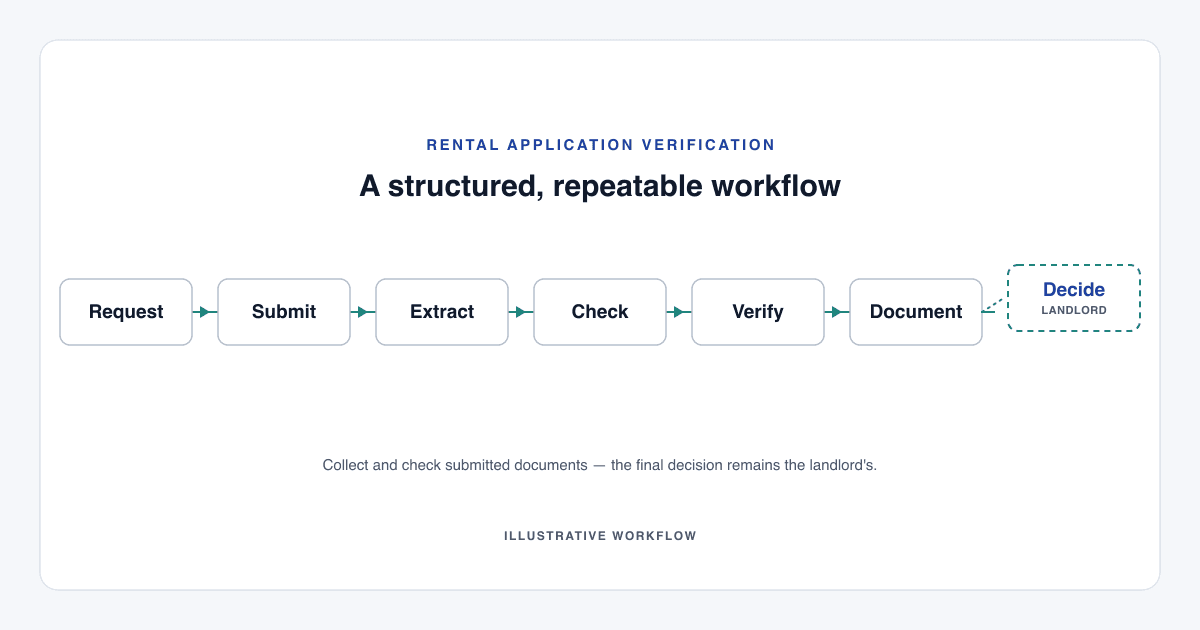
- Rental application verification is a structured review of the documents an applicant submits — not a background check, a credit report, or a decision about the applicant.
- Use the same documented workflow for every applicant — request, collect securely, review for internal and cross-document consistency, verify further when needed, and record what you checked.
- An inconsistency is a prompt to ask a specific question or request more documentation — never, on its own, proof of wrongdoing.
- Verification produces findings; the rental decision, and responsibility for following fair-housing and consumer-report law, remain the landlord's.
If you review rental applications yourself, you have probably felt the gap between "I looked at the documents" and "I ran a consistent, defensible review." This guide closes that gap. It describes a complete workflow for verifying the documents in a rental application — what to request, how to check it, what to do when something does not line up, and where document review ends and your own decision begins.
The short version: verification is a structured review of submitted evidence for internal and cross-document consistency. It tells you whether the documents an applicant gave you agree with each other and with what was stated on the application. It does not, by itself, decide who becomes your tenant — that decision, and the responsibility to apply it lawfully, stay with you.
What rental application verification means
- Rental application verification
Reviewing the documents an applicant submits — pay stubs, bank statements, and supporting records — to confirm that the information is internally consistent, consistent across documents, and consistent with what the applicant stated. It is a review of submitted evidence, not an independent investigation of the applicant.
Verification answers a narrow, useful question: do the documents in front of me hold together? When an applicant states an income figure, a recent pay stub and a few months of bank statements should tell a coherent story. When they do, the documentation supports the stated income. When they do not, you have a specific, factual reason to ask for more before you proceed.
What verification does not determine
Most confusion in rental review comes from collapsing four separate things into one. Keeping them apart is what makes a review both useful and fair.
The verification workflow — what this guide covers: collecting documents and checking them for consistency.
Your screening criteria — the lawful, written standards you decide to apply (and apply the same way to everyone).
Legal compliance — fair-housing law, consumer-report duties, and state and local rules that govern how you screen and decide.
The rental decision — the choice to proceed, or not, which is yours alone.
Verification lives entirely in the first layer. It is not a background check, a public-records search, a credit report, or an eviction-history lookup — those are separate processes, run through different providers, with their own legal obligations. It does not set an income threshold for you, and it does not tell you whom to select. A document review that stays in its lane is more trustworthy precisely because it does not pretend to do the other three jobs.
The documents commonly involved
For most applications, verification centers on a small, familiar set of documents:
Pay stubs — recent employment income, pay frequency, and year-to-date totals.
Bank statements — the deposit side of the income picture, over a defined period.
Supporting records for non-traditional income — for self-employment, contract, gig, retirement, or benefit income, records such as tax documents, benefit-award letters, or business statements stand in for pay stubs.
How many of each to request, and how to read them, are topics in their own right — see the rental application verification checklist for a printable list, verifying rental applicant income for the income-specific method, and the bank statement review guide for reading a statement. This guide focuses on the workflow that ties them together.
The end-to-end workflow
A complete verification is a repeatable sequence, not a one-off look. The diagram below shows the whole flow. Every stage before the decision is document review; the decision itself sits outside that boundary because it is yours to make.
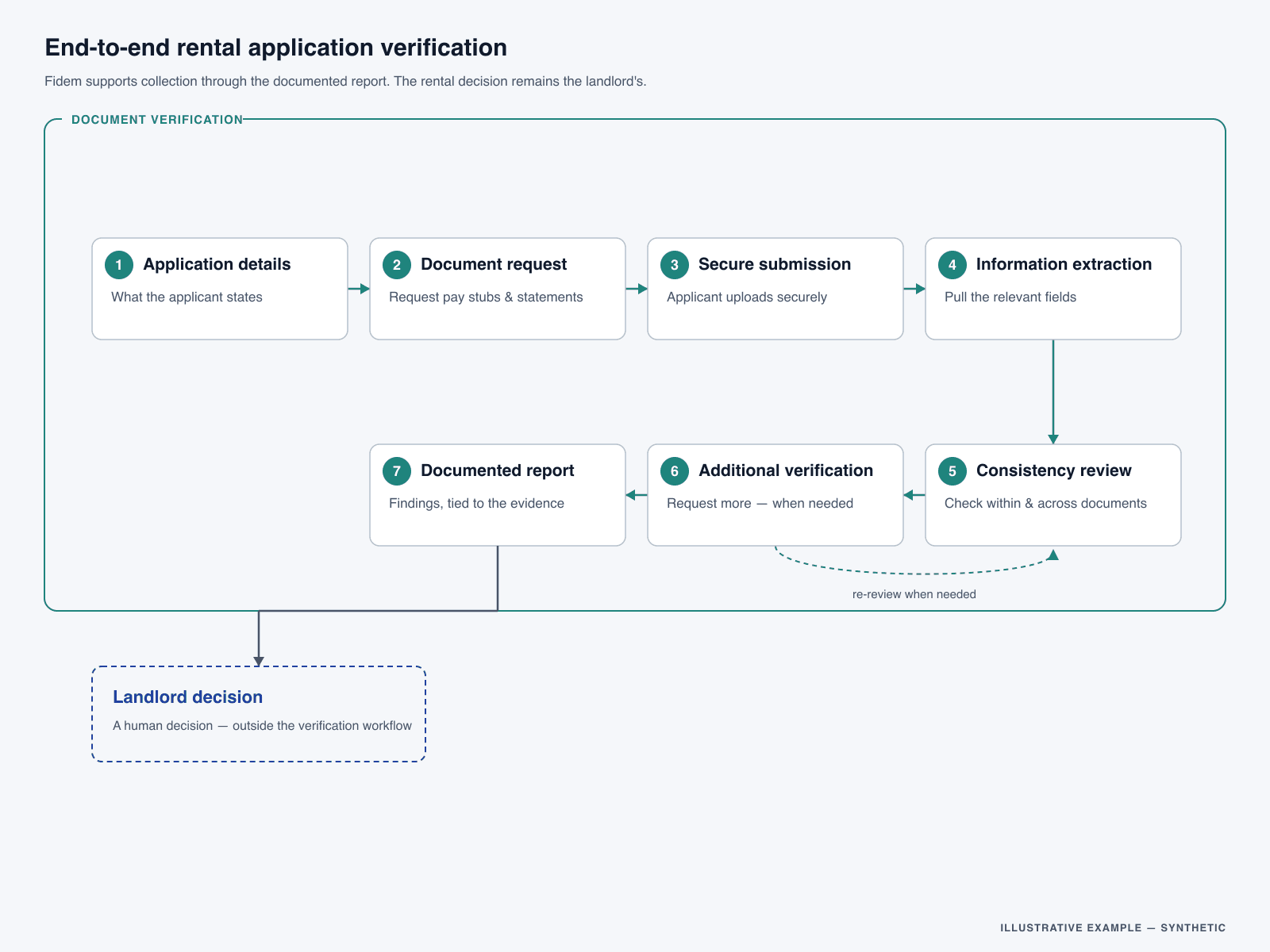
- 1. Application details:
- What the applicant states — income, employer, and the figures you will check the documents against.
- 2. Document request:
- Ask for the specific documents your review needs, such as recent pay stubs and bank statements.
- 3. Secure submission:
- The applicant provides documents through a secure channel rather than ad hoc email attachments.
- 4. Information extraction:
- Pull the relevant fields from each document so you can compare them.
- 5. Consistency review:
- Check each document internally and compare across documents and against the application.
- 6. Additional verification:
- When something does not line up or is missing, request a clarification or the missing document.
- 7. Documented report:
- Record what you reviewed and what you found, tied to the supporting evidence.
- Landlord decision:
- A human decision that sits outside the verification workflow. Verification informs it; it does not make it.
The same seven stages, as steps you can run for every applicant:
Start from what was stated
Note the income and employment the application claims. These are the figures your document review will check against.
Request the documents you need
Ask for specific, recent documents — not everything imaginable. Request only what your review actually uses.
Collect them securely
Use a secure upload path rather than email, and limit who can see the files once they arrive.
Extract the relevant fields
Identify the fields you will compare: gross and net pay, pay frequency, year-to-date totals, deposit amounts and dates, employer name.
Review for consistency
Check each document against itself, across documents, and against the application. Note where things align and where they do not.
Verify further when needed
For any gap or mismatch, request a specific clarification or the missing document before proceeding.
This is a neutral next step, not a conclusion about the applicant.
Document the review
Record what you checked, what you found, and what you requested, so the review is repeatable and defensible.
Applying the workflow consistently
The single most important property of a good verification process is that it is the same for every applicant. Consistency is what keeps a review fair, comparable, and defensible — and it aligns with the principle, reflected in federal guidance on tenant selection, that screening standards should be written down and applied uniformly to all applicants.
Consistency governs what you check and how, not what you conclude. It does not mean demanding identical paperwork from people in different situations; a salaried employee and a self-employed applicant evidence income differently. It means the baseline review runs the same way each time, and any departure — for example, accepting tax documents in place of pay stubs — is deliberate and written down. For a concrete, adoptable template, see how to build a consistent rental application verification process.
Reviewing submitted evidence for consistency
Consistency review has two layers: within a single document, and across documents.
Internal consistency asks whether a document agrees with itself. On a pay stub, for instance, the year-to-date figure should be roughly consistent with the stated pay frequency and the number of pay periods elapsed — the field definitions the CFPB publishes for reading a pay stub are a good reference for what each figure means.
Cross-document consistency asks whether documents agree with each other and with the application.
| Check | Documents involved | What you are looking for |
|---|---|---|
| Stated vs. observed income | Application, pay stubs, bank statements | Deposits broadly consistent with the stated and pay-stub income |
| Pay frequency vs. year-to-date | Pay stubs | Year-to-date total that fits the stated frequency and periods elapsed |
| Employer name | Pay stubs, bank statement deposit descriptors | The same employer appearing consistently across documents |
| Dates and periods | Pay stubs, bank statements | Overlapping, current periods rather than gaps or mismatched ranges |
When these line up, the documentation supports the stated income. When they do not, you have identified something specific to ask about — not a verdict.
Handling missing or inconsistent information
Documents are frequently incomplete or hard to read, and applicants are not always at fault. A blurry scan, a missing pay period, or a figure that does not match is a routine part of review, not evidence of wrongdoing. The right response is neutral and specific:
Missing — request the specific item ("please provide the January and February pay stubs").
Unreadable — request a clearer copy.
Inconsistent — ask a specific, factual question about the discrepancy before drawing any conclusion.
For a staged decision path that routes each of these situations to a specific, neutral next step, see how to handle missing, unreadable, or conflicting documents.
Independent research reinforces the need for this care: the CFPB has documented meaningful accuracy problems in third-party tenant-screening reports, which is a strong reason to give applicants a chance to clarify rather than treat any single data point as settled.
Requesting additional verification
When the baseline documents leave a gap, additional verification is simply the next step in the same workflow. Keep requests specific, proportionate, and applied consistently: ask for the particular document or clarification the review needs, communicate in neutral, document-focused language, and record the request. Framing matters — "additional verification is needed on the year-to-date figure" is accurate and respectful; language that implies you have caught someone is neither.
Documenting your review
The record is as important as the review. A documented review is repeatable, comparable across applicants, and defensible if a decision is ever questioned. For each application, capture:
What to record for every application
- Which documents were submitted, and when
- Which fields you reviewed in each document
- What was consistent and what was not
- Any clarification or additional documentation you requested, and the response
- A short summary of your findings, tied to the supporting evidence
Keeping this record consistently is also what makes the fairness principle above real: it demonstrates that every applicant went through the same process.
Protecting applicant financial information
Pay stubs and bank statements are sensitive financial documents. Handling them responsibly is part of the workflow, not an afterthought. The FTC's guidance for businesses handling personal information offers a practical baseline: collect only what your review needs, keep it secure, limit who can access it, and dispose of it securely when it is no longer needed. For the full collection-to-deletion lifecycle, see a landlord's guide to applicant financial document privacy.
Where verification stops — and your decision begins
Verification ends with a documented set of findings. The decision to proceed with an applicant is separate, and it is yours. Two boundaries are worth stating plainly.
Fair housing. Screening criteria should be lawful, written down, and applied consistently to every applicant; they must never rely on a protected characteristic. Requirements also vary by state and locality — some jurisdictions, for example, restrict consideration of source of income. Verification supports a consistent process, but it does not determine your compliance.
Consumer reports and adverse action. If your process also uses a third-party screening or background report, the Fair Credit Reporting Act imposes specific duties — including providing an adverse-action notice when a report contributes to an unfavorable decision. The FTC's guidance for landlords explains these obligations. Document verification on submitted materials is distinct from using a consumer report, but if you do both, the report carries its own responsibilities.
How Fidem supports the workflow
Common questions
Is verification the same as a background check?
No. Verification reviews the documents an applicant submits for consistency. A background check queries third-party records (such as public-records or eviction history) through a separate provider and carries its own legal obligations.
Does a discrepancy mean the applicant did something wrong?
No. A discrepancy means the documents do not yet agree or are incomplete. It is a reason to ask a specific question or request more documentation — not a conclusion about the person.
How much income documentation should I require?
Enough to review consistently, matched to how the applicant is actually paid. There is no single national rule; what matters is applying your standard consistently and accepting reasonable alternative documentation for non-traditional income. See verifying rental applicant income for detail.
Does verification tell me whether to rent to someone?
No. It produces findings about the documents. The decision — and the responsibility to make it lawfully and consistently — is yours.
Sources
- Using Consumer Reports: What Landlords Need to Know — Federal Trade Commission (accessed 2026-07-13)
- The Fair Housing Act — U.S. Department of Housing and Urban Development (accessed 2026-07-13)
- HUD Occupancy Handbook 4350.3, Chapter 4 — Waiting List and Tenant Selection — U.S. Department of Housing and Urban Development (accessed 2026-07-13)
- Tenant Background Checks Market Report — Consumer Financial Protection Bureau (accessed 2026-07-13)
- Understanding Your Pay Stub — Consumer Financial Protection Bureau (accessed 2026-07-13)
- Protecting Personal Information: A Guide for Business — Federal Trade Commission (accessed 2026-07-13)
Legal and regulatory statements cite primary federal sources (FTC, HUD, CFPB), verified on the access dates shown; requirements vary by jurisdiction and change over time. Product statements describe Fidem's document-verification workflow only. No unsourced statistics are used.