
Key Takeaways
- A document you never collect has no copies to track and nothing to dispose of - ask only for the records your review actually needs, and request the same core set from every applicant.
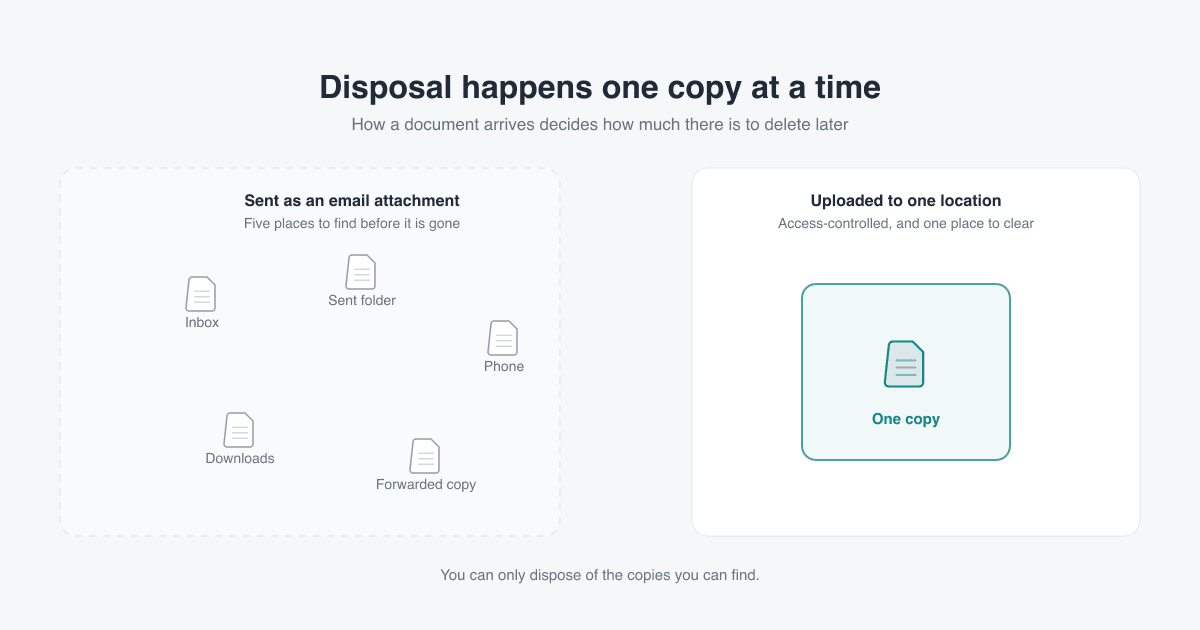
- Disposal happens one copy at a time and only reaches the copies you can find, so how a document arrives decides how much there is to clean up later.
- Most of what you hold belongs to applicants you did not choose; when the vacancy fills, the reason to keep their documents has largely ended.
- Decide who can open the documents, how long you will keep them, and how you will dispose of them before you collect anything, not once your inbox is already full.
- These are proportionate privacy practices, not legal advice; collecting less and keeping it for less time reduces exposure, but does not by itself establish legal compliance, and requirements vary by jurisdiction.
Say a vacancy draws five applications. Each applicant sends recent pay stubs, often a bank statement or two, sometimes a tax document. You rent the unit to one of them.
Weeks later the other four sets are still in your inbox, holding employers, salaries, account balances, account numbers, and spending history belonging to people who are not your tenants and never will be. Nothing about an ordinary week will prompt you to go and remove them.
That pile is the harder half of applicant privacy. Protecting the document you are actively reading is largely a matter of care while you are looking at it. The material you stopped needing months ago is a different problem, because by the time you think about deleting it, it exists in several places and you no longer know all of them.
Disposal happens one copy at a time
Every document you collect has a copy count, and that count is mostly settled on the day it arrives.
Ask for pay stubs by email and the file lands in your inbox, sits in the applicant's sent folder, rests on two mail providers' servers, and syncs to every device signed into that mailbox. Open the attachment to read it properly and there is now one in your downloads folder. Forward it to a co-owner for a second opinion and the count rises again. None of those copies knows about the others.
Deletion runs the other way. It happens one copy at a time, and only to the copies you can still find. The Federal Trade Commission's guidance for businesses handling personal information is direct about the channel itself, noting that regular email is not a secure method for sending sensitive data. For a landlord the practical consequence is narrower than a security policy. The number of places you let a document land on the day it arrives largely decides whether you can clean it up later at all.
- Data minimization
Collecting and keeping only what a specific purpose actually needs, for only as long as it needs it. It is the cheapest control available to a landlord, because a document you never requested has no copies to track, nothing to secure, and nothing to dispose of.
Decide four things before you ask
Four decisions are worth making before a single document arrives, because each is much harder to apply retroactively: what the review actually needs, who will open it, how long you intend to keep it, and what you will ask of every applicant. Which records a review genuinely needs is its own question, worked through in the complete rental application verification guide, and for income specifically in verifying applicant income.
Before you collect
- Define the purpose of the review and the specific documents it actually needs, so you can ask for those and nothing more.
- Decide in advance who will need to open the documents, and keep that list of people as short as the review allows.
- Decide how long you plan to keep the documents and when you will revisit that, rather than defaulting to keeping them indefinitely.
- Plan to request the same core set from every applicant and to handle it the same way, so the process stays consistent.
Getting documents in without spreading them
A secure upload channel is not really about encryption. It is about the document arriving in one place instead of five, with an access list you control rather than a mail thread you do not. The same reasoning rules out an open shared link, which is a channel whose copy count you cannot see.
Collect and transmit securely
- Request documents through a secure upload channel rather than email attachments or texted photos.
- Tell the applicant what you are requesting and why, so the request is clear and easy to act on.
- Avoid shared links that anyone with the link can open; use access-controlled delivery instead.
- Collect only the documents this applicant's situation calls for, rather than a blanket demand for every financial record.
While the review is open
Your exposure while the review runs comes down to how many copies exist and how many people can open them.
Store with limited access
- Store the documents in an access-controlled location, not a shared drive, personal email, or a consumer file-sharing account.
- Avoid unnecessary copies: skip local downloads and forwarded attachments you do not need to keep.
- Limit who can open the documents to the people actually involved in the review.
- Keep the raw documents separate from your review notes where practical, so a note can be shared without the underlying document.
The review is also where sensitive figures escape the documents that contain them. A year-to-date total gets pasted into a spreadsheet, or an account number is quoted in a message to a co-owner. That data now outlives the file it came from, and no disposal routine aimed at documents will ever reach it.
Review without over-copying
- Record what you reviewed and what you found, rather than copying full document contents into your records.
- Keep account numbers and other sensitive figures out of free-text notes and messages.
- Share the documents only with people who need them for the review, and only for as long as they need them.
When something is missing or does not reconcile, ask for that one thing. Requesting a fresh full set collects more than the open question needs and restarts the copy problem from the beginning. For the neutral way to decide that next step, see handling missing, unreadable, or conflicting documents.
Follow up narrowly
- Request only the specific item an open finding needs, rather than asking the applicant to resend a full new set of documents.
- Use the same secure channel for re-submission that you used to collect the documents.
- Note what you requested and when, without restating sensitive figures in the note.
The applicants you did not choose
The FTC ties retention to a business reason instead of a calendar. Keep sensitive data only as long as you have a business reason to hold it, its guidance for businesses says, and once that need is over, dispose of it properly.
For a landlord that standard has an unusually clear trigger. When the vacancy fills, the reason to hold documents from the applicants you did not choose has largely ended, and it ended on a specific, knowable day. A signed tenant's file is a separate question, and disputes, legal holds, and record-keeping duties can properly extend the period for anyone. For the rest of the pile, though, the filled vacancy is both the right moment and the only one you will reliably notice.
Setting a review date instead tends to fail quietly, because the date arrives on an ordinary day when nothing is prompting you to think about documents at all.
Retain for a defined period
- Write down why you are keeping the documents and for how long, based on your jurisdiction and legitimate business need.
- Set a date to review whether you still need them, so retention is a decision rather than a default.
- Account for disputes, legal holds, and any record-keeping requirements that apply to you when you set the period.
What secure disposal actually means
Deleting is not disposing. The FTC is explicit that deleting files with keyboard or mouse commands usually is not sufficient, because the files may continue to exist on the drive and can be retrieved. Paper needs shredding, burning, or pulverizing. Electronic media needs a wipe utility that overwrites the data.
Every copy has to be found first, which is where the count you set back at collection time comes due.
Dispose securely
- Delete electronic copies from every place you stored them, including downloads, email, and shared folders.
- Shred, burn, or pulverize paper documents rather than discarding them intact.
- Remember that moving a file to the trash is not the same as secure disposal; use a secure-delete or wipe method for electronic media.
- Record that disposal was completed and what it covered, where practical.
The tools in the middle
Storage services, application platforms, and verification products all hold documents on your behalf, and each brings its own copy count and its own retention behavior. Two questions settle most of it: where does this tool put the file, and what makes it go away. A tool that cannot answer the second one is a place your documents accumulate. Using a tool distributes the work. It does not transfer the responsibility.
Account for vendor handling
- Understand where a tool stores the documents and how long it keeps them.
- Confirm what a tool does and does not do with document contents, and prefer tools that document their handling and retention.
- Remember that using a vendor does not remove your own responsibility for the documents you collect.
If something goes wrong anyway
Careful handling still produces a misaddressed email or a folder shared wider than intended. This is also the moment your copy count stops being housekeeping and becomes a question you have to answer, because working out who was affected means knowing exactly what was in the exposed location and whose it was. Deciding the first few moves in advance is worth more than it sounds, since the first hour is the one that matters and it is a poor time to be reading about notification requirements for the first time.
Plan for accidental disclosure
- If documents are exposed or accessed without authorization, contain the access first - revoke sharing, reset access, and stop the spread.
- Preserve the relevant records so you can understand what was involved and what happened.
- Assess what was affected and follow any notification and legal requirements that apply to your situation and jurisdiction.
- Review the process afterward and adjust it so the same exposure is less likely next time.
Download the checklist
The full collection-to-deletion checklist as a printable PDF, containing the identical items shown above.
Applicant Financial Document Privacy Checklist (printable)PDF · 10 KBScope and obligations
How Fidem supports secure handling
Common questions
How long should I keep applicant financial documents?
There is no single correct period, and you should be wary of anyone who offers one. Tie the period to a reason instead of a number. Hold the documents while you have a business reason to, account for disputes, legal holds, and any record-keeping duty that applies to you, and dispose of them once that reason ends. For applicants you did not rent to, that reason usually ends when the vacancy is filled.
Is deleting a file the same as securely disposing of it?
No. Moving a file to the trash generally leaves it recoverable, and it does nothing about the copies sitting in downloads, email, and shared folders. Secure disposal means finding every copy, using a secure-delete or wipe method for electronic media, and shredding, burning, or pulverizing paper.
Do I need to do any of this for applicants I did not rent to?
Those documents have the least remaining reason to exist, which makes them the first candidates for disposal rather than the last. Unless a dispute, a legal hold, or a record-keeping duty applies, a filled vacancy is a reasonable point to clear them, and doing so is the single largest reduction available in what you are holding.
Sources
- Protecting Personal Information: A Guide for Business — Federal Trade Commission (accessed 2026-08-14)
- Disposing of Consumer Report Information? Rule Tells How — Federal Trade Commission (accessed 2026-08-14)
- FTC Safeguards Rule: What Your Business Needs to Know — Federal Trade Commission (accessed 2026-08-14)
- Data Security — Federal Trade Commission (accessed 2026-08-14)
- Tenant Background Checks and Your Rights — Federal Trade Commission (accessed 2026-08-14)
Data-minimization, secure-handling, and disposal practices are cited to the FTC's guidance for businesses handling personal information, and to the FTC's Disposal Rule summary for both the rule's requirements and its stated applicability, including the FTC's own list of who must comply. The Safeguards Rule is cited as an applicability boundary rather than a duty, and the FTC Data Security hub for the collect-less framing; applicant rights and the consumer-report boundary are cited to the FTC's applicant-facing guidance. All five sources were re-read and re-verified on 2026-08-14. Product statements describe Fidem's document-handling workflow only, verified against Fidem's retention contract and product-boundary documentation; they do not claim a deletion guarantee, a security certification, or third-party handling beyond what that documentation supports. No statistics are used, and no jurisdiction-specific rule is asserted as universal.